
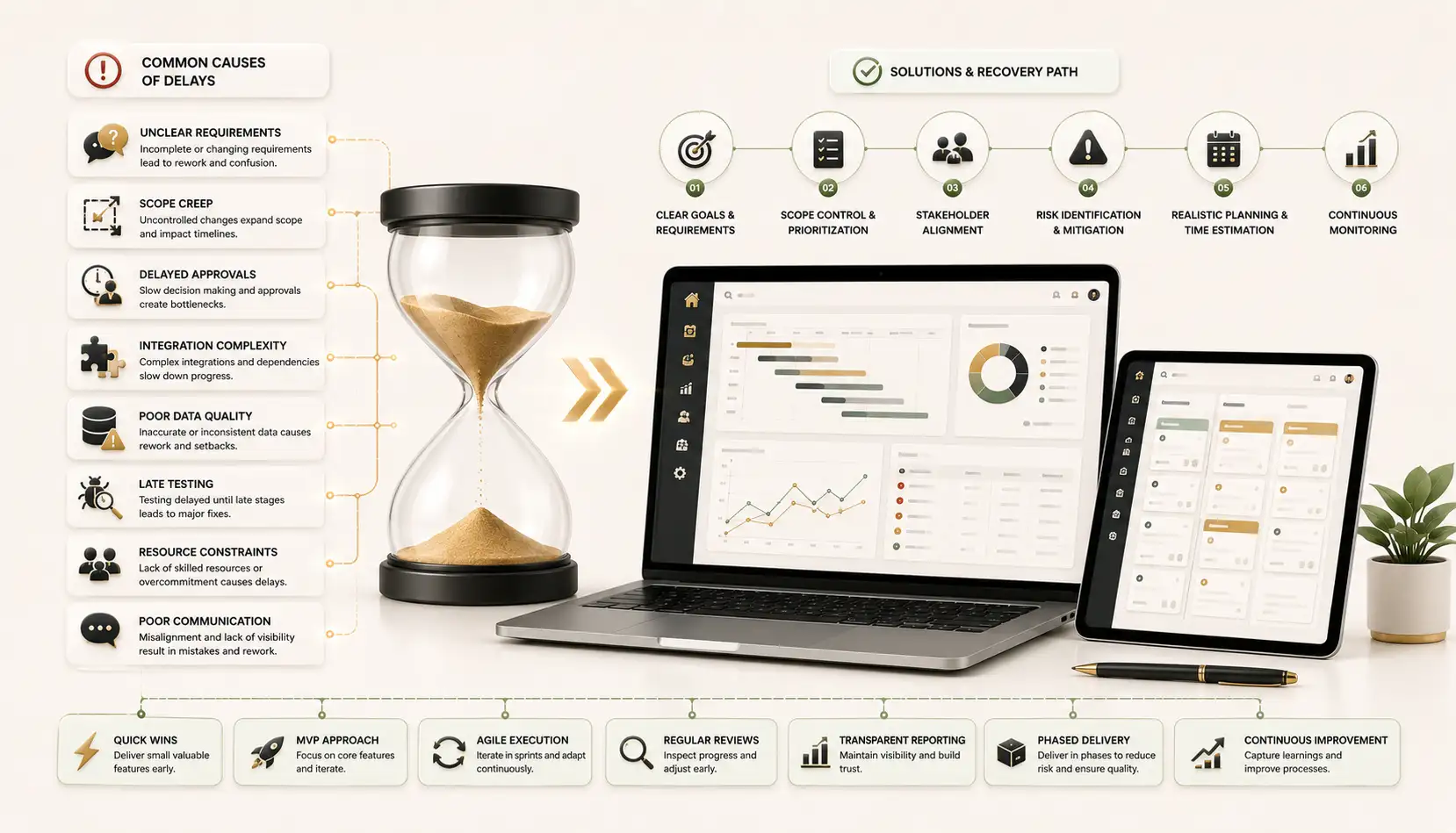
Software projects rarely fall behind because of one spectacular disaster.
Delays usually develop gradually. Requirements change, decisions take longer than expected, integrations become more complex, testing begins late, or key employees are unavailable.
By the time the delay becomes visible to senior management, several weeks may already have been lost.
Understanding the common causes of software project delays can help businesses plan more realistically and respond earlier.
Unclear Requirements
A project cannot move efficiently when the team does not know what it is expected to build.
Statements such as “We need a customer portal” or “We want to automate sales” describe a general direction, not a complete set of requirements.
The team needs to understand:
- Who will use the system
- Which tasks users must complete
- What information is required
- Which approvals are involved
- Which systems must be integrated
- What reports are needed
- Which security rules apply
- What success looks like
Unclear requirements lead to repeated discussions, rework, and conflicting expectations.
Frequent Scope Changes
Changes are normal in software development. Businesses learn more as they review prototypes and early versions.
The problem begins when new features are added continuously without adjusting the timeline, budget, or priorities.
A project that began as a simple ordering application may gradually expand to include inventory, payments, delivery tracking, loyalty points, advanced reporting, and multilingual support.
Each feature may be useful, but together they create a very different project.
A formal change process helps decision-makers understand the impact before approving additional work.
Slow Decision-Making
Development teams often depend on business stakeholders for decisions.
They may need approval for:
- Designs
- Workflows
- Content
- Data rules
- Payment providers
- User permissions
- Reports
- Integrations
When feedback takes several weeks, the development team may be unable to proceed.
The client organization should assign responsible decision-makers and define reasonable review periods.
A delayed approval is still a project delay, even when the developers are ready to continue.
Integration Complexity
Connecting new software to existing systems is often more difficult than expected.
The older system may have incomplete documentation, limited APIs, inconsistent data, or unusual security requirements.
Third-party providers may also introduce delays by changing specifications, restricting access, or taking time to approve integrations.
Integration risks should be investigated early rather than left until the final stage.
Poor Data Quality
A new application may depend on data from spreadsheets, legacy systems, or manual records.
If that data contains duplicates, missing fields, incorrect codes, or inconsistent formats, migration takes longer.
Teams may need to clean, map, and validate information before it can be used.
Data preparation should begin early, especially when the project involves customer records, products, financial history, or inventory.
Limited User Involvement
Software is often approved by managers but used by employees who were not involved in planning.
When users finally test the system, they may identify missing steps, unrealistic workflows, or practical problems.
For example, a field sales application may require representatives to complete too many screens during a short customer visit. A warehouse system may use product descriptions that employees do not recognize.
Involving users early helps the team identify these issues before development is complete.
Underestimating Testing
Testing is sometimes treated as the final task before launch.
In reality, software should be tested throughout development.
Testing may include:
- Functional testing
- Integration testing
- Security testing
- Performance testing
- Device testing
- Browser testing
- User acceptance testing
- Data migration testing
- Accessibility review
If testing begins late, important defects may require major changes close to the planned launch date.
Resource Availability
Projects depend on people with specific knowledge.
A key developer, business analyst, department manager, or subject expert may become unavailable due to competing work, leave, or organizational changes.
External vendors may also have limited availability.
Resource planning should identify critical roles and provide alternatives where possible.
Unrealistic Deadlines
Some deadlines are selected before the project scope is understood.
A business may announce a launch date based on a conference, marketing campaign, or financial period. The technology team is then expected to fit the work into the chosen schedule.
A fixed deadline is not always impossible, but the scope must be adjusted accordingly.
The team may need to release a smaller first version and move lower-priority features into later phases.
Weak Project Communication
Poor communication creates assumptions.
Developers may believe a feature is approved, while the business team expects another review. Stakeholders may assume data preparation is the vendor’s responsibility, while the vendor expects the client to provide clean files.
Regular project updates should cover:
- Completed work
- Upcoming tasks
- Decisions required
- Risks
- Changes
- Testing results
- Dependencies
- Timeline impact
Good reporting does not prevent every delay, but it makes problems visible earlier.
Practical Example
Imagine a retailer developing a mobile ordering application.
The initial requirement is to allow customers to browse products and submit orders. During development, the business adds online payments, loyalty points, delivery tracking, promotional codes, product recommendations, and customer chat.
At the same time, the inventory system does not provide reliable real-time stock information. Product photographs arrive late, and management takes two weeks to approve each design.
The development team may still be working efficiently, but the project will almost certainly miss its original deadline.
A better approach would divide the project into phases.
The first release could include account creation, product browsing, ordering, and basic payment. Loyalty, recommendations, and live chat could follow after the core system has been tested with real customers.
How to Reduce Delays
Businesses can reduce project risk by:
- Defining objectives clearly
- Prioritizing requirements
- Assigning decision-makers
- Reviewing integrations early
- Preparing data in advance
- Involving users
- Testing throughout development
- Managing changes formally
- Monitoring risks
- Planning phased releases
A realistic plan should also include contingency. Software projects involve discovery, and not every technical challenge can be predicted perfectly.
The Value of a Minimum Viable Product
A minimum viable product, or MVP, includes the smallest set of features needed to deliver value and test the solution.
An MVP does not mean releasing careless or insecure software. It means controlling scope.
The business can launch essential features, collect feedback, and improve the product in stages.
This approach can reduce delays caused by trying to include every possible feature before the first release.
Final Thoughts
Software projects are delayed by unclear requirements, uncontrolled changes, slow decisions, difficult integrations, poor data, late testing, and unrealistic schedules.
Most of these risks can be reduced through better planning and communication.
Businesses preparing a new platform can review NUR Technology Solutions’ Custom Software Development service:
https://nurtechnologysolutions.com/services/software-development/custom-software-development/
A successful software project is not one that avoids every challenge. It is one that identifies challenges early, makes informed decisions, and keeps the project focused on the business outcome.
Request Information
Interested in Software Project Management?
NUR Technology Solutions
Discuss Your Technology Requirement
Explore the related service or contact our team to discuss a tailored solution for your organization.
Discuss Your Software Project