A corporate documentary is more than a long advertisement.
At its best, it tells a meaningful story about a company, its people, its work, or its impact. It can explain complex ideas, preserve organizational history, build trust, and give audiences a reason to care.
Unlike a short promotional video, a documentary format usually provides more context. It may include interviews, real environments, archival material, customer experiences, employee perspectives, and evidence of results.
This makes corporate documentaries a powerful communication tool.
Turning Business Information Into a Story
Companies often communicate through reports, presentations, brochures, and press releases. These formats are useful, but they may not capture emotion or human experience.
A documentary can transform business information into a story.
Instead of stating that a manufacturing company supports local employment, the film can introduce employees, show their daily work, and explain how the company has affected their families and community.
Instead of publishing a paragraph about innovation, a documentary can follow the development of a new product from an early idea to final production.
Storytelling helps audiences understand not only what the company does, but why it matters.
Building Trust Through Real Voices
Audiences are often skeptical of highly polished promotional claims.
Documentaries can build credibility by featuring real customers, employees, partners, experts, and community members.
Their voices provide different perspectives on the company.
For example, a hospital documentary may include doctors, nurses, patients, and administrators. A construction documentary may include engineers, workers, clients, and local residents.
The film should still be professionally planned, but the interviews should feel authentic rather than memorized.
Explaining Complex Services
Some businesses provide services that are difficult to explain in a short advertisement.
Software development, engineering, logistics, healthcare, financial services, and industrial manufacturing all involve processes that customers may not fully understand.
A documentary can show these processes visually.
A technology company could follow a project from discovery and design to development, testing, and launch. Viewers would see the collaboration and problem-solving involved, rather than hearing only a list of services.
This can support both marketing and customer education.
Supporting Internal Communication
Corporate documentaries are not only for external audiences.
They can be used internally to communicate:
- Company history
- Strategic direction
- Organizational change
- Safety culture
- Employee achievements
- Values
- Leadership transitions
- Merger stories
- Major project milestones
A documentary about the organization’s history can help new employees understand how the company developed.
A film about a major transformation can show the reasons for change and recognize the employees involved.
Employer Branding
Job candidates want to know what it is like to work at a company.
A recruitment documentary can provide a more realistic view than a careers-page slogan.
It may show:
- Different departments
- Employee experiences
- Training
- Workplace culture
- Career progression
- Community activities
- Leadership philosophy
The goal should not be to present a perfect workplace. Honest stories are usually more credible.
A documentary can help candidates decide whether the organization is a good fit, which may improve recruitment quality.
Corporate Social Responsibility
Companies involved in education, environmental projects, community development, healthcare, or social initiatives often need to communicate impact.
A documentary can show the people and places connected to these programs.
However, the film should avoid treating communities as decorative marketing material. Participants should be represented respectfully, and claims should be supported by evidence.
The strongest impact documentaries focus on real outcomes rather than exaggerated praise.
Practical Example
Consider an agricultural company introducing a sustainability program for small-scale farmers.
A standard corporate video might feature senior executives describing the initiative.
A documentary approach would go further.
The film could follow several farmers over a season. It could show training sessions, changes in farming practices, challenges, and results. Agronomists, company employees, and community leaders could provide context.
The final film would help customers, investors, employees, and partners understand how the program works in practice.
The documentary could also be adapted into shorter clips for social media, presentations, recruitment, and stakeholder meetings.
One production could therefore support several communication channels.
Planning a Corporate Documentary
A successful documentary begins with a clear communication objective.
The company should ask:
- Who is the audience?
- What should viewers understand?
- Which story best supports that message?
- Who should be interviewed?
- What locations should be filmed?
- Which evidence or historical material is available?
- Where will the documentary be shown?
- How long should it be?
The story should guide the production. Beautiful footage cannot compensate for an unclear message.
The Importance of Pre-Production
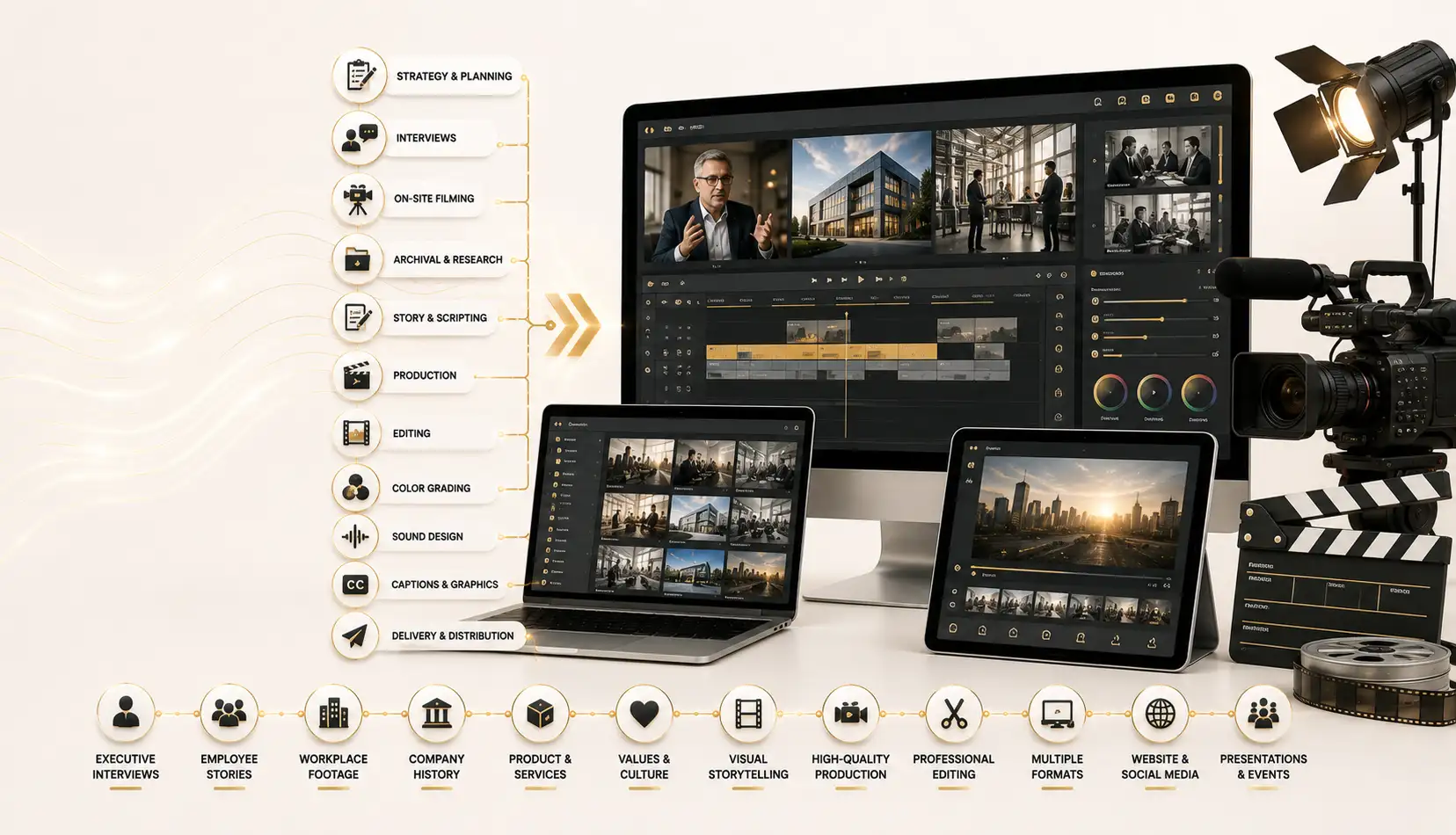
Pre-production includes research, interviews, story development, scheduling, location planning, permissions, and production design.
This stage is particularly important for corporate documentaries because filming often involves busy workplaces, employees, customers, and sensitive information.
The production team may need to coordinate:
- Site access
- Safety requirements
- Brand guidelines
- Interview availability
- Release forms
- Confidentiality
- Travel
- Equipment
- Legal review
Careful planning reduces disruption and helps the production capture authentic moments.
Distribution Matters
A documentary should be planned for the platforms where it will appear.
A 20-minute film may work well at a corporate event, stakeholder meeting, or website. Shorter versions may be better for social media.
The business can create several assets from the same production:
- Full documentary
- Short trailer
- Employee interview clips
- Customer stories
- Social media excerpts
- Event version
- Internal training segments
- Behind-the-scenes content
This extends the value of the project.
Measure Communication Outcomes
Success should not be measured only by video views.
The company may also consider:
- Audience completion rates
- Engagement
- Employee feedback
- Recruitment inquiries
- Stakeholder responses
- Media interest
- Event reactions
- Website conversions
- Use by sales teams
The measurement method should match the original communication objective.
Final Thoughts
Corporate documentaries help businesses communicate through stories, people, and real environments.
They can build trust, explain complex work, strengthen internal culture, support recruitment, and demonstrate social impact.
Organizations planning a documentary or business video can review the Corporate Video Production service from NUR Technology Solutions:
https://nurtechnologysolutions.com/services/digital-marketing/corporate-video-production/
A memorable corporate documentary does not simply tell viewers that a company is important. It shows them why.
---
Request Information
Interested in Corporate Video Production?
NUR Technology Solutions
Discuss Your Technology Requirement
Explore the related service or contact our team to discuss a tailored solution for your organization.
Explore Corporate Video Production