
Schools manage much more than classrooms and examinations.
Every day, administrators coordinate student records, attendance, fees, timetables, teachers, assessments, communication, transport, documents, and parent requests. When these activities are handled through separate spreadsheets, paper files, and messaging groups, information can become difficult to track.
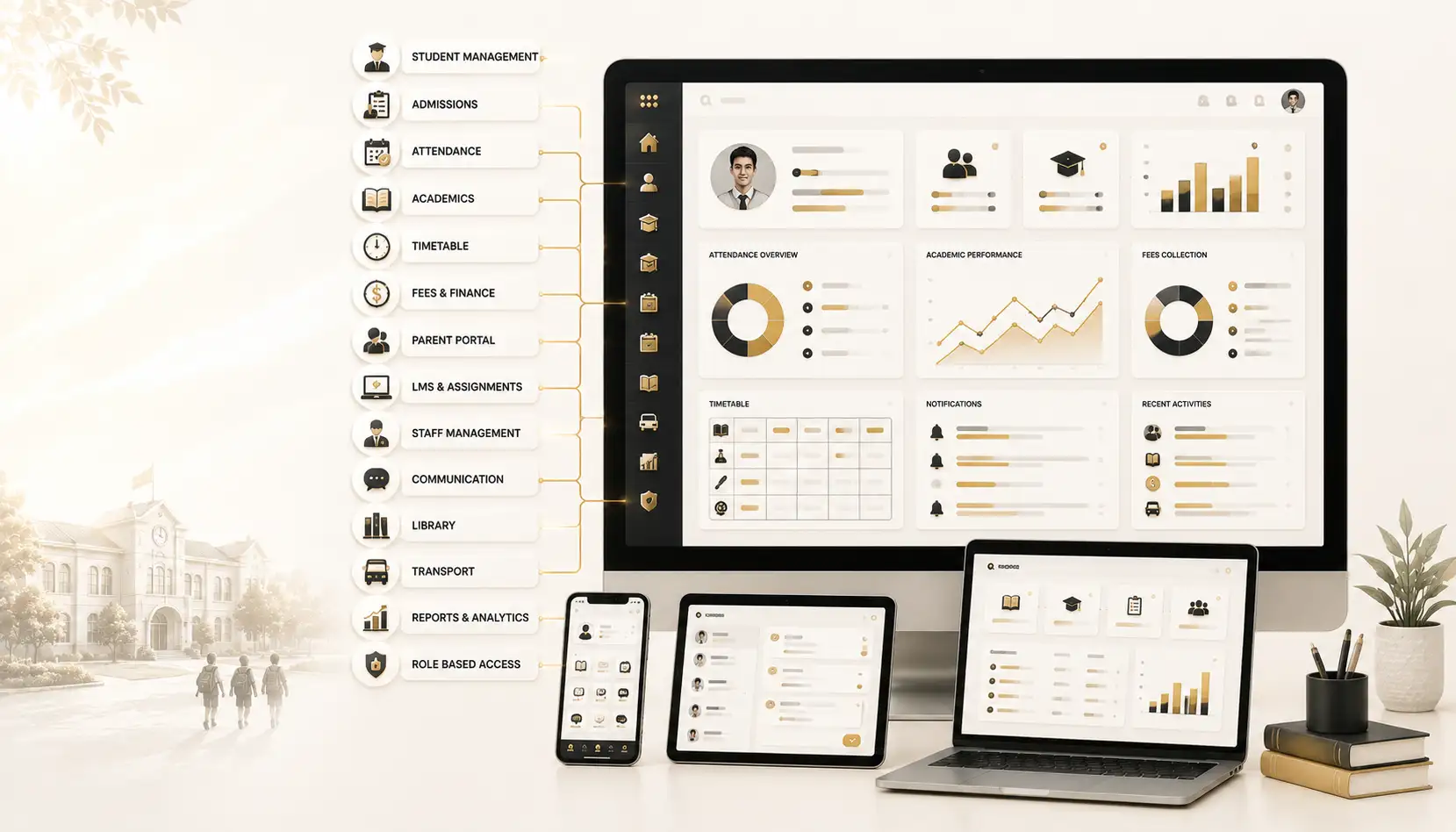
A school management system brings core academic and administrative processes into one platform.
However, not every school needs the same features. A successful system should reflect the institution’s size, curriculum, structure, and operating procedures.
Student Information Management
The student record is the foundation of a school management system.
Each profile may include:
- Student name and identification number
- Date of birth
- Grade and class
- Parent or guardian information
- Contact details
- Admission history
- Medical notes
- Uploaded documents
- Academic records
- Attendance
- Fee status
The system should allow authorized users to update information while maintaining appropriate privacy and access controls.
A centralized student record prevents departments from maintaining conflicting versions of the same information.
Admissions and Enrollment
Admissions can involve inquiries, applications, document collection, interviews, assessments, approvals, and fee payments.
A digital admissions module can guide families and administrators through this process.
Parents may be able to submit applications online, upload documents, and receive status updates. Administrators can review applications, record decisions, and convert approved applicants into enrolled students.
This reduces paperwork and makes the admissions process easier to monitor.
Attendance Management
Attendance should be simple for teachers and useful for administrators.
Teachers may record attendance through a web or mobile interface. The system can then generate daily, weekly, or monthly reports.
It may also send notifications when a student is absent, depending on the school’s communication policy.
Attendance reports can help schools identify frequent absence, late arrival patterns, and class-level trends.
Timetable and Scheduling
Creating a timetable is more complicated than placing subjects into empty periods.
The school must consider:
- Teacher availability
- Classroom availability
- Subject requirements
- Grade schedules
- Laboratory access
- Breaks
- Shared facilities
- Special activities
A timetable module can reduce scheduling conflicts and make updates easier to communicate.
Academic Management
The academic module should allow schools to manage subjects, assignments, examinations, grading, report cards, and progress records.
Teachers should be able to enter marks efficiently, while administrators should define grading structures and approval processes.
Parents and students may receive controlled access to results through a portal or application.
The system should support the school’s actual assessment method rather than forcing every institution into the same grading model.
Fee and Payment Management
Fee management is one of the most important administrative functions.
The platform may support:
- Fee categories
- Payment schedules
- Discounts
- Scholarships
- Installments
- Receipts
- Outstanding balances
- Late payment rules
- Financial reports
Online payment integration may also be included where appropriate.
A clear payment history reduces disputes and allows administrators to identify outstanding accounts quickly.
Parent and Student Portals
A self-service portal can reduce routine calls and office visits.
Parents may use the portal to view:
- Attendance
- Results
- Announcements
- Fee statements
- Payment receipts
- Timetables
- Assignments
- School calendars
- Teacher messages
Students may access lessons, assignments, schedules, and academic feedback.
Access should be role-based so users see only the information relevant to them.
Learning Management Features
A school management system handles administration, while a learning management system focuses more directly on teaching and learning.
Some institutions may benefit from combining both.
Learning features can include:
- Course materials
- Video lessons
- Assignments
- Quizzes
- Discussion spaces
- Progress tracking
- Certificates
- Teacher feedback
NUR Technology Solutions provides information about learning platforms through its Learning Management System service page:
https://nurtechnologysolutions.com/services/business-solutions/learning-management-system/
Staff Management
The system may also maintain teacher and employee information.
Useful features include:
- Staff profiles
- Department assignment
- Attendance
- Leave requests
- Work schedules
- Subject allocation
- Performance records
- Payroll integration
Sensitive staff information should be protected through appropriate permissions.
Communication Tools
Schools communicate with parents, students, teachers, and administrators every day.
A management platform may support email, text messages, push notifications, portal announcements, or in-app messaging.
Messages can be targeted by class, grade, activity, or user group.
This is more controlled than relying entirely on informal messaging groups.
Library, Transport, and Hostel Modules
Depending on the institution, additional modules may be required.
A library module can manage books, borrowing, returns, and overdue items.
A transport module can manage routes, vehicles, drivers, students, and pickup points.
A hostel module can support room assignments, resident records, payments, and supervision.
These features should be included only when they solve a genuine operational need.
Practical Example
Imagine a private school with 1,200 students.
Admissions are managed through paper forms. Teachers record attendance in registers. Examination marks are entered into spreadsheets. Parents call the office to confirm fee balances and request report cards.
The school introduces a centralized system in phases.
First, student records, attendance, and fee management are digitized. Teachers begin recording attendance through tablets. Parents receive access to a portal where they can view statements, receipts, announcements, and results.
Later, the school adds online assignments and learning materials.
The system reduces repetitive administrative work and gives families quicker access to information. More importantly, the school creates a reliable record of academic and administrative activity.
Security and Privacy
School systems contain personal information about children, families, and employees.
Security should include:
- Role-based permissions
- Strong authentication
- Secure backups
- Audit logs
- Data encryption where appropriate
- Controlled document access
- Account deactivation procedures
- Incident response planning
The institution should also consider applicable education and privacy requirements in its operating location.
Final Thoughts
A school management system should make administration easier without making school life more complicated.
Core features usually include student records, admissions, attendance, timetables, academics, fees, communication, and self-service access. Additional modules should be selected based on the institution’s real needs.
The most successful systems are designed around the way teachers, administrators, students, and parents actually work.
Schools exploring digital learning and education-management tools can review the NUR Technology Solutions Learning Management System page:
https://nurtechnologysolutions.com/services/business-solutions/learning-management-system/
A well-planned platform does not replace the human side of education. It gives educators more time and better information to support it.
---
Request Information
Interested in Education Technology?
NUR Technology Solutions
Discuss Your Technology Requirement
Explore the related service or contact our team to discuss a tailored solution for your organization.
Explore Learning Management Solutions