For many years, digital visibility was primarily associated with search engine optimization. Businesses created useful website content, targeted relevant keywords, earned links, and improved technical performance to appear in search results.
That foundation still matters, but the way people discover information is changing.
Users now search through traditional search engines, voice assistants, featured answers, AI-powered summaries, chat interfaces, and generative search experiences. This has led to greater attention around three related approaches: SEO, AEO, and GEO.
Rather than treating them as competing strategies, businesses should understand how they support one another.
What Is SEO?
Search engine optimization, or SEO, is the process of improving a website’s visibility in organic search results.
SEO generally includes three major areas.
Technical SEO focuses on how easily search engines can crawl, understand, and index a website. It includes areas such as page speed, mobile performance, site structure, internal linking, structured data, and indexation.
On-page SEO focuses on the content and organization of individual pages. It includes headings, titles, search intent, keyword relevance, readability, and content quality.
Off-page SEO includes external signals such as backlinks, brand mentions, and online authority.
The purpose of SEO is not simply to insert keywords. It is to make a website more useful, understandable, accessible, and relevant.
What Is AEO?
Answer engine optimization, or AEO, focuses on making content easy for search platforms and digital assistants to use when providing direct answers.
A user may ask:
“What is sales force automation?”
“Which software is best for managing school attendance?”
“How can a company reduce inventory errors?”
An answer engine may provide a concise response without requiring the user to read several pages first.
To support AEO, content should present clear and direct answers. Useful techniques include:
- Question-based headings
- Concise definitions
- Frequently asked questions
- Structured data
- Step-by-step explanations
- Comparison tables
- Clearly organized sections
- Natural language
AEO does not mean writing only brief content. A page can provide a direct answer near the top and then offer a detailed explanation for readers who need more context.
What Is GEO?
Generative engine optimization, or GEO, refers to improving the likelihood that content will be understood, selected, summarized, or cited by generative AI systems.
The field is still developing, and there is no guaranteed formula for appearing in an AI-generated answer.
However, content is generally more useful to both humans and machines when it demonstrates:
- Clear expertise
- Accurate information
- Original insights
- Strong structure
- Transparent authorship
- Reliable references
- Consistent terminology
- Specific examples
- Up-to-date explanations
GEO encourages businesses to think beyond rankings. The goal is to create information that can contribute meaningfully to a generated response.
How SEO, AEO, and GEO Support One Another
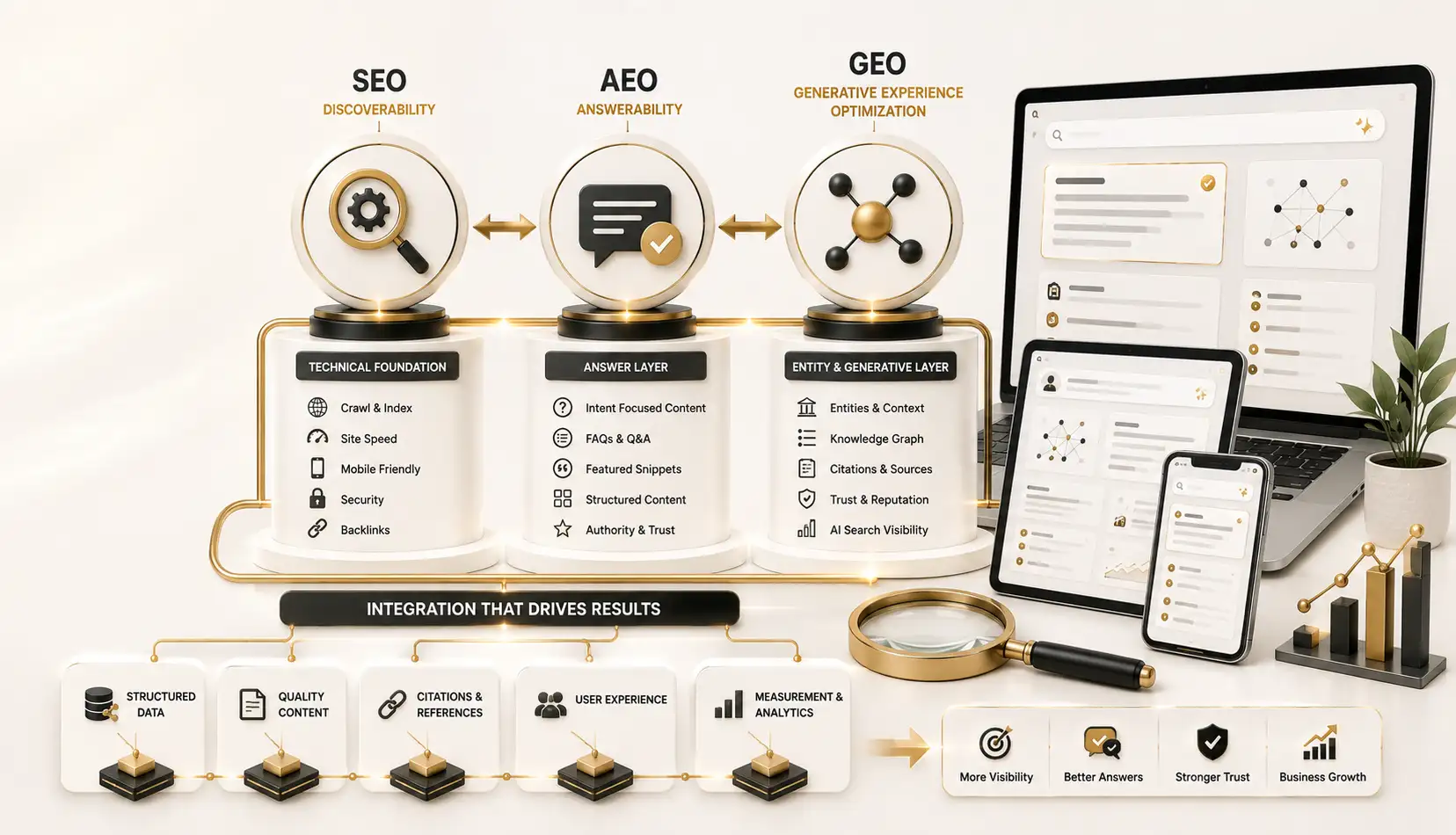
SEO creates the technical and content foundation.
AEO improves the clarity of answers.
GEO strengthens the depth, credibility, and usefulness of the information.
Consider an article titled “What Is a Customer Self-Service Portal?”
An SEO-focused version would target relevant search terms, use a descriptive page title, include internal links, and load quickly.
An AEO-focused version would provide a clear definition near the beginning and answer common questions such as “What features should a customer portal include?”
A GEO-focused version would add original explanations, practical examples, implementation considerations, expert commentary, and credible supporting sources.
The strongest page would combine all three approaches.
Practical Example
Imagine a software company that publishes a service page about mobile app development.
The original page contains only a few paragraphs describing the service. It may rank for the company name, but it does not answer detailed customer questions.
The company expands the page to explain:
- The difference between native and cross-platform development
- When each approach is appropriate
- Typical project stages
- Security considerations
- Integration requirements
- Common cost factors
- Frequently asked questions
The page is then improved technically with descriptive headings, structured data, internal links, image optimization, and better mobile performance.
This updated page is more useful in several ways. Search engines can understand its subject more clearly. Answer engines can extract direct explanations. Generative systems have richer, more structured information to summarize.
The page also becomes more persuasive to prospective customers because it demonstrates expertise rather than simply promoting a service.
Content Quality Matters More Than Terminology
Businesses should be cautious about chasing every new marketing abbreviation.
Adding the phrase “GEO optimized” to a content plan does not automatically improve visibility. The fundamentals remain important:
- Understand the audience
- Answer genuine questions
- Publish accurate information
- Demonstrate experience
- Improve website usability
- Build authority over time
- Keep important content current
Poor-quality content will not become valuable simply because it uses question headings or structured data.
Create Content Around Customer Journeys
SEO, AEO, and GEO work best when content addresses different stages of the customer journey.
A potential customer may begin with an educational question such as “What is custom software?”
Later, the same person may search for “custom software vs off-the-shelf software.”
Closer to making a decision, the person may look for “custom software development company” or “questions to ask a software developer.”
A strong content strategy creates useful pages for each stage and connects them through internal links.
Measure More Than Rankings
Traditional keyword rankings are still useful, but they do not provide a complete picture.
Businesses should also monitor:
- Organic traffic
- Qualified inquiries
- Search impressions
- Click-through rates
- Engagement
- Branded searches
- Conversions
- Assisted conversions
- Mentions and citations where measurable
- Performance of question-based content
The objective is not visibility for its own sake. The objective is meaningful attention from the right audience.
Final Thoughts
SEO, AEO, and GEO are different lenses for improving digital visibility.
SEO helps content become discoverable. AEO helps platforms identify direct answers. GEO helps generative systems understand and use trustworthy, well-structured information.
Businesses do not need three separate content departments. They need a unified strategy built around technical quality, useful answers, credible information, and strong customer understanding.
Organizations interested in improving their search presence can review the Search Engine Optimization service from NUR Technology Solutions:
https://nurtechnologysolutions.com/services/digital-marketing/search-engine-optimization/
The future of search may involve more formats and interfaces, but one principle is unlikely to change: the most valuable content is the content that genuinely helps people.
---
Request Information
Interested in Digital Marketing?
NUR Technology Solutions
Discuss Your Technology Requirement
Explore the related service or contact our team to discuss a tailored solution for your organization.
Explore SEO, AEO and GEO Services