Most businesses begin with off-the-shelf software. It is affordable, quick to deploy, and often good enough for managing everyday tasks such as accounting, customer records, communication, or inventory.
However, as a business grows, “good enough” can become a costly limitation.
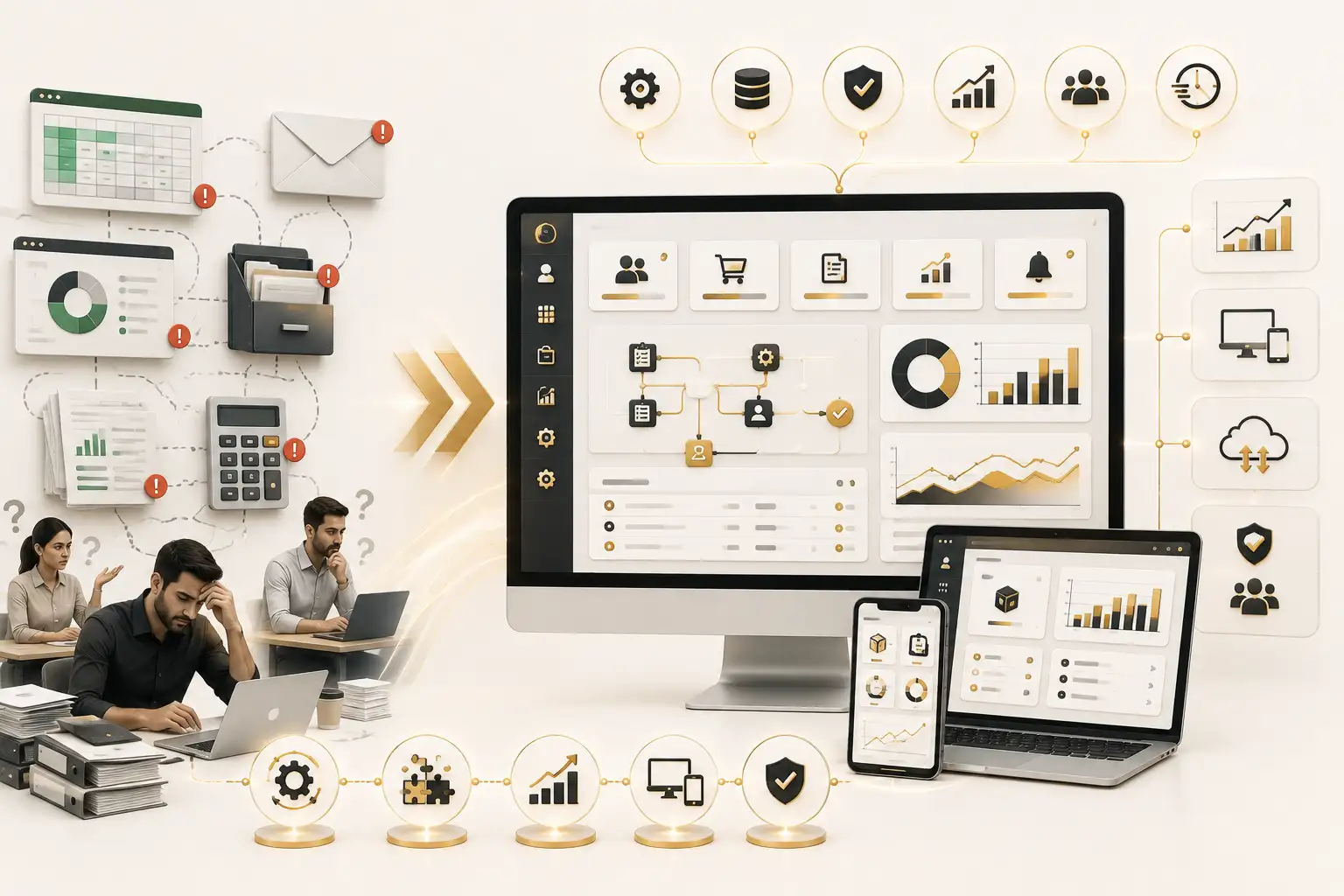
Employees may start copying information between systems, relying on spreadsheets, repeating the same manual tasks, or creating workarounds because the software no longer matches the way the company operates. At that point, custom software may be a practical business investment rather than a luxury.
Your Team Relies Heavily on Manual Work
One of the clearest signs that a company needs custom software is the amount of manual work involved in routine operations.
For example, employees may need to:
- Enter the same customer information into several systems
- Prepare reports manually
- Update spreadsheets every day
- Send repetitive status emails
- Transfer sales orders from one platform to another
- Reconcile data between departments
These activities consume time and increase the risk of errors.
Custom software can automate repetitive processes and connect information across departments. Instead of asking employees to manage disconnected tools, the software can be designed around the company’s actual workflow.
Existing Software Does Not Fit Your Process
Standard software is created for a broad market. It usually provides common features that many businesses may need, but it may not support specialized processes.
A logistics company, for instance, may need a delivery system that combines route planning, driver assignment, customer notifications, proof of delivery, and billing. A generic project management platform may handle tasks and deadlines, but it may not support all the operational details required by the logistics team.
When employees must constantly adjust their process to fit the software, the company may benefit from a tailored solution.
Custom software allows the technology to follow the business process, rather than forcing the business to follow the limitations of the technology.
Your Systems Do Not Communicate
Many businesses use separate tools for sales, accounting, inventory, customer support, and reporting. Problems arise when these systems do not share information.
A salesperson may confirm an order without seeing that the product is out of stock. The finance team may issue an invoice before receiving updated delivery information. Customer service representatives may struggle to answer questions because they cannot access order records.
Custom software can connect these systems through integrations, centralized databases, and automated data flows. This creates a more consistent view of the business.
Growth Is Making Operations More Difficult
Growth should create opportunities, but it can also expose weaknesses in a company’s systems.
A process that works well for 100 customers may become difficult to manage with 10,000 customers. A spreadsheet that tracks a small number of orders may become slow, inaccurate, and difficult to secure as transaction volumes increase.
Businesses experiencing rapid growth often need systems that can support:
- More users
- Higher transaction volumes
- Multiple locations
- New services
- More complex approval processes
- Increased reporting requirements
Custom software can be built with scalability in mind, allowing the system to grow alongside the organization.
Customers Expect a Better Digital Experience
Customers increasingly expect convenient digital services. They may want to place orders online, track deliveries, access documents, submit service requests, or receive real-time updates.
If competitors provide these conveniences while your company still relies on phone calls and email, customer satisfaction may suffer.
A custom customer portal, ordering platform, booking system, or mobile application can make services easier to access while reducing pressure on internal teams.
Security or Compliance Requirements Are Increasing
Some industries handle sensitive customer, financial, educational, or operational data. Generic applications may not always provide the level of access control, audit tracking, or workflow management that the organization requires.
Custom software can be designed with role-based permissions, approval processes, data validation, audit trails, and security controls suited to the company’s environment.
However, custom development does not automatically guarantee security. Security should be considered throughout planning, development, testing, deployment, and ongoing maintenance.
Practical Example
Consider a growing wholesale distributor that receives orders through email, phone calls, and messaging applications. Sales representatives record orders in spreadsheets, while warehouse staff use another system to track stock. The finance team then re-enters the information into accounting software.
As order volumes rise, several problems appear. Products are occasionally promised when stock is unavailable, invoices contain errors, and managers cannot see an accurate daily sales picture.
A custom order management platform could centralize customer records, stock availability, approvals, invoicing, and delivery updates. Sales representatives would be able to confirm availability before completing an order, while managers could monitor performance through real-time dashboards.
The result would not simply be “new software.” It would be a more reliable way of operating the business.
Questions to Ask Before Investing
Before starting a custom software project, a business should define the problem clearly.
Important questions include:
- Which process is causing the greatest delay or cost?
- Who will use the software?
- Which existing systems must be integrated?
- What information should the system collect?
- Which reports are required?
- How will success be measured?
- Who will maintain the software after launch?
The company should also compare the cost of custom development with the ongoing cost of inefficiency, manual errors, licensing fees, and lost opportunities.
Final Thoughts
A business may need custom software when existing tools create more work than they remove. Repetitive manual tasks, disconnected systems, poor scalability, and limited customer experiences are all signs that a tailored solution may be appropriate.
The goal is not to build software simply because custom technology sounds impressive. The goal is to solve a measurable business problem.
Organizations exploring tailored applications can review the Custom Software Development service from NUR Technology Solutions:
https://nurtechnologysolutions.com/services/software-development/custom-software-development/
A well-planned custom system can improve efficiency, create better visibility, and give a business the flexibility to evolve without being restricted by unsuitable technology.
---
Request Information
Interested in Custom Software Development?
NUR Technology Solutions
Discuss Your Technology Requirement
Explore the related service or contact our team to discuss a tailored solution for your organization.
Explore Custom Software Development